Tom McCarthy’s anthropological satire, Satin Island, is best described by the fictional anthropologist himself: 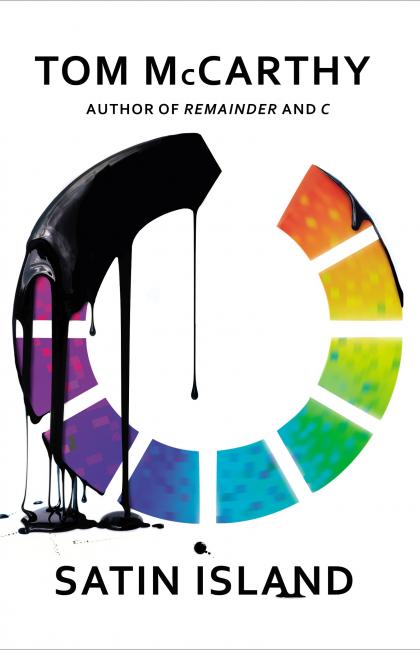
When these events (events! if you want those, you’d best stop reading now) took place, I found myself deployed not to some remote jungle, steppe or tundra… but to a business… I was the in-house ethnographer for a consultancy
McCarthy’s narrator, the very meta ‘U’, lays out his role as a commercial anthropologist, but he may as well be reviewing his own manuscript for Satin Island, which is global in scope and macro at sentence level. The narrative style is that of a report, beginning with chapters and parts: 1.1, 1.2, 1.3, and so on, or otherwise mimic the ‘versioning’ of software updates. Big events happen within a single claus—‘we had sex’—whilst lone images span a page or more. We are given glimpses of the ubiquitous ‘Koob-Sassen project’ which, we are told, has infiltrated our lives like fluoride in drinking water, undetected, divisive and toxic in large doses. Our only option, however, is to follow the stream of consciousness of an individual. But U, as a narrator, is capable of creating mystery from the everyday.
U becomes fixated on oil spills and parachute malfunctions, but fails any detective work concerning the bigger picture. Koob-Sassen is allusive, unobserved cultures are allusive, U’s sex scenes with his friend, Madison, are allusive. Things—events, truths, connections and links—feel just out of reach at all times. And this desire for some ultimate answer to a grand question (asked by whom?) sucks you into his own delusion, until the very end, where U becomes lost in the well-documented fog of male ennui. He loses credibility during the non-events acknowledged at the beginning; the book suddenly ends.
I read Satin Island as part of a writing module, and many readers in the group felt U was entirely serious and unaware of his own bluster—a kind of scholarly purple prose, as though McCarthy enjoys his own cleverer-than-thou style. I think that misses the point. The novel envelopes and regurgitates its own bogus theories. U deciphers celestial space as ‘the sky was a crime scene’ after the death of a parachutist is deemed suspicious, then later acknowledges his own academidrivel*. Take this–I warn you–lengthy example:
Why are your walls covered in pictures of parachutes? asked Tapio when he popped his head into my office one day. It’s to do with the Project, I told him; it’s overall… configuration. Oh yes? he said in his robotic voice. Yes, I repeated: there are these strands, and they converge; and there’s and overarching roof—or, let’s say, membrane, skin—above them. And, I continued, warming to my theme, what powers the whole thing isn’t some internal engine, since it doesn’t have one, but rather the way its structure, due to the way it’s, you know, structured, generates kinetic energy as everything around it—in this case, the air—passes through it.
I admire U’s ability to talk himself into his own ideas. The way profundity is forceable given the right threat and stimulus; something I very much enjoy about McCarthy’s writing in general is an ability to decipher the intellectual weight of words, ‘configuration’, as opposed to say ‘structure’. He mocks the carefully logocentric world of nuanced ideas. Characters are warded off the trail of U’s procrastination by the right words in the right combination: a rhetorical equivalent of ‘the boss is here, look busy!’. When U addresses the reader, he is convincing, like we are to ourselves. When he addresses his peers, he saves himself only by smashing together ideas with the right lexical epoxy.

When writing, I look back on McCarthy’s prose for it’s brave punctuation. His writing is littered with it, or rather, configured by it. In the small passage above, ellipsis, em dashes, numerous commas, multiple clauses. It’s very baroque and at the same time controlled–a conversational style that cossets a reader before a terrible reveal. It’s worth the effort for its style, especially if reading Satin Island serves to remind to your better-reads that ‘you must seek out his debut, Remainder’.
.
*the irony.
 Fionn Wills