Half of the fun is fixing typewriters. My current record stands at 3 in 4 typers arriving and needing some immediate attention to get them functioning properly, despite ‘good working order’ descriptions. Soon I’ll start hunting the old fashioned way, in reclamation centres and thrift houses to get up close before adopting another basket case. This Smith-Corona didn’t arrive as a basket case, but the carriage would not return all the way to the right. Turns out that seventy year old catgut isn’t such a reliable drawband. I’ve added some photos of what it was like when I found the frayed, looped and hardened drawband wrapped around the mainspring (which is very small and note: only needs three turns on this model, not six like on Brother-style portables). Also, my Corona’s spring makes and incredible ‘ching’ sound when you wind it up, not a quiet ‘tink’ like the Brother. This noise gave me palpitations until I realised the spring hadn’t broken.

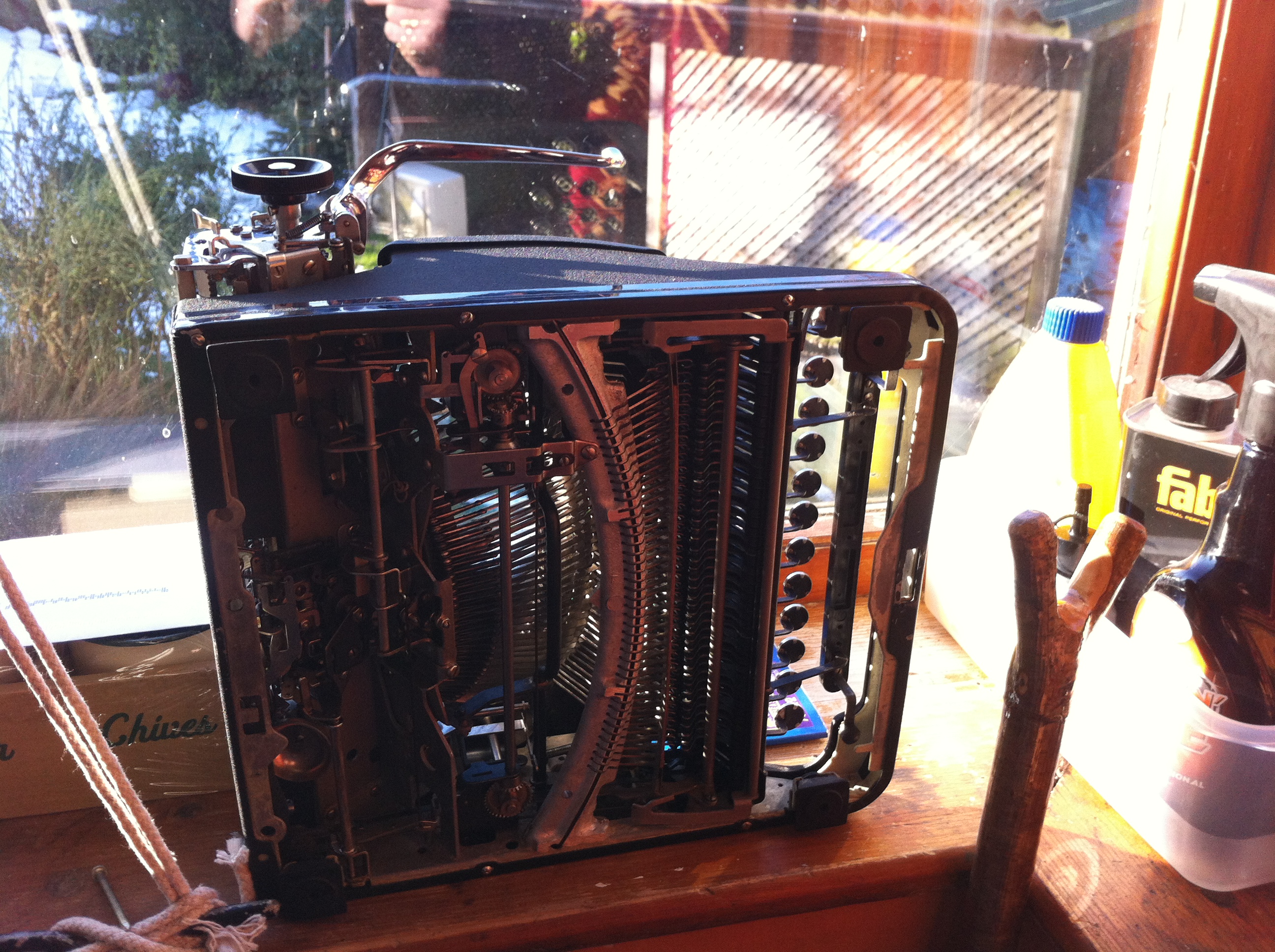
On the Sterling the end of the drawband has a neat little hook that fastens over a small screw on the carriage. I’d intended to replace the catgut with more reliable fishing wire but given this little hook (a miniscule piece on such a large machine) I didn’t feel like getting rid of the original part. So onward ho, for the catgut. After unhooking the drawband I pulled it through the carriage to the opposite side to make untangling it easier as it had gotten into a tangle so bad, I can’t imagine how it happened. A little white spirit seemed to soften it too.
The turn of the screw was daunting (the title of a good short story by Henry James too), and because of this I set up the carriage with two turns on the spring. That returned the carriage, but only half way: no good. THREE turns is perfect, if a little fiddly to get the hook back through the carriageway. I fashioned a tool from a hairgrip and a chopstick (see below) that worked great and looks a lot like the tool used by the Egyptians to fish Pharaoh’s brains out of his skull via the nose.


After doing a lot of research on the typewriter forum, oz.typewriter and many others (including my nearest typewriter mechanic’s number), the job was worth the trouble and ended up being good fun to explore the mechanics and get it right. You’ve earned it when you’ve fixed it: the font is big and bold and serifed just right, the touch is very light and the Bakelite keys are easy touch-typers. After, dislodging a metric ton of dust and cleaning the filthy type-slugs I wrote out two pages of stream of consciousness drivel just to try every button. Well worth the work, catgut and all and for £50 all in, who can argue with that? Corona over Chromebook every time. As you can tell I’m smitten with it. The previous owner ‘remembers hunting and pecking his school homework on it in Canada and South Africa’. Most of my typewriters are better travelled than I am, so now it’s time to get to work on remedying that.

As I said, manual machines, when they go wrong, are fun to fix. Still frustrating, patience still needed in bucket loads, but they aren’t going to freeze on you, the problem isn’t buried in an oblique miasma of binary or html code, no loading bars will move along at the speed of erosion, and the interface once fixed, is fixed.
 Fionn Wills